

Conclusion + Action Plan
From Insight to Action
Shaping my next steps as a teacher
My worked example developed over the period of this unit. Highlighted are my adjustments

My Placement School - Murwillumbah East
Murwillumbah East Public School is a small school in the Northern Rivers region with 152 students, including 16% Aboriginal or Torres Strait Islander students. According to the My School website data (Australian Curriculum, Assessment and Reporting Authority [ACARA], n.d.), the school’s ICSEA value of 935 and percentile ranking of 19 suggest the community experiences lower socio-educational advantage than many Australian schools. This may impact students’ access to educational resources, literacy experiences and academic support outside of school (Duchesne, 2019, p. 464). As a result, it is important as a pre-service teacher to implement explicit, structured, and inclusive teaching strategies that support engagement, literacy development, and equitable learning outcomes. Implementing pre and post-assessment data, check-in assessments, and targeted intervention will ensure a responsive and informed approach to improving student outcomes (NSW Department of Education, n.d)
According to the Murwillumbah East Public School website (NSW Department of Education, n.d.), the school is a dynamic, creative and inclusive environment that prioritises innovative and explicit teaching and learning experiences. The school has a strong whole-school focus on improving reading literacy and numeracy outcomes while promoting equity and opportunity through initiatives such as the Deadly Program (NSW Department of Education, n.d.). I will ensure my commitment to cultural responsiveness, authentically embedding Aboriginal and Torres Strait Islander perspectives into my teaching practice.
Effective classroom management is developed through an ongoing cycle of rehearsal, practice, feedback and reflection (AERO, 2023). Building positive teacher–student relationships through clear expectations, consistent routines, and respectful communication helps create a safe, supportive, and predictable learning environment (AERO, 2023). To implement this, I will greet students at the door, consistently use their names, use clear visual schedules, provide transition countdowns, model routines explicitly, use attention signals, rehearse routines, and use positive reinforcement language. I now understand the importance of building positive teacher-student relationships and recognise the value of these evidence-based approaches in supporting both student wellbeing and academic engagement, while implementing predictable rules and routines to maximise learning time (AERO, 2023).
As I prepare for placement, Brad Gobby’s (2022) discussion of the different forms of curriculum — including the official, negotiated, enacted, hidden, null and lived curriculum has influenced my thinking, as Gobby explains, that although the official curriculum provides the framework for teaching, each teacher’s interpretation and pedagogical choices shape students’ learning experiences differently. The learning environment itself acts as a “third teacher,” influencing how students feel, interact and learn. When I imagine the classroom I hope to create, I envision a warm, colourful, collaborative and culturally inclusive space that values diversity and belonging. I aim to create an environment that incorporates cultural perspectives, open-ended resources and opportunities for collaborative learning, recognising the important role that classroom spaces play in supporting student engagement and learning (Merewether, 2022, p. 307).
Australian Education Research Organisation. (2023). Classroom management: Creating and maintaining positive learning environments. AERO.
Australian Education Research Organisation. (2024). Worked examples. AERO.
Australian Education Research Organisation. (2025). How students learn. AERO.
Australian Curriculum, Assessment and Reporting Authority. (n.d.). My School: Murwillumbah East Public School. My School.
Duchesne, S., McMaugh, A., Bochner, S., & Krause, K.-L. (2019). Educational psychology for learning and teaching (6th ed.). Cengage Learning Australia.
Gobby, B. (2022). What is curriculum? In B. Gobby & R. Walker (Eds.), Powers of curriculum: Sociological perspectives on education (Chapter 1). Oxford University Press.
Merewether, J. (2022). Environment as Curriculum. In B. Gobby & R. Walker (Eds.), Powers of curriculum: Sociological perspectives on education (Chapter 15). Oxford University Press.
https://myschool.edu.au/school/43967
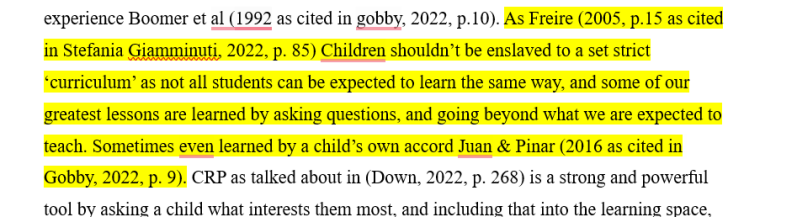
A snippet from an assessment Contesting Curriculum- one of my favourite units.
Transition Ideas
