


Gibbs Reflection Cycle -
Phase Four - Analysis
Turning my Experience into Insight
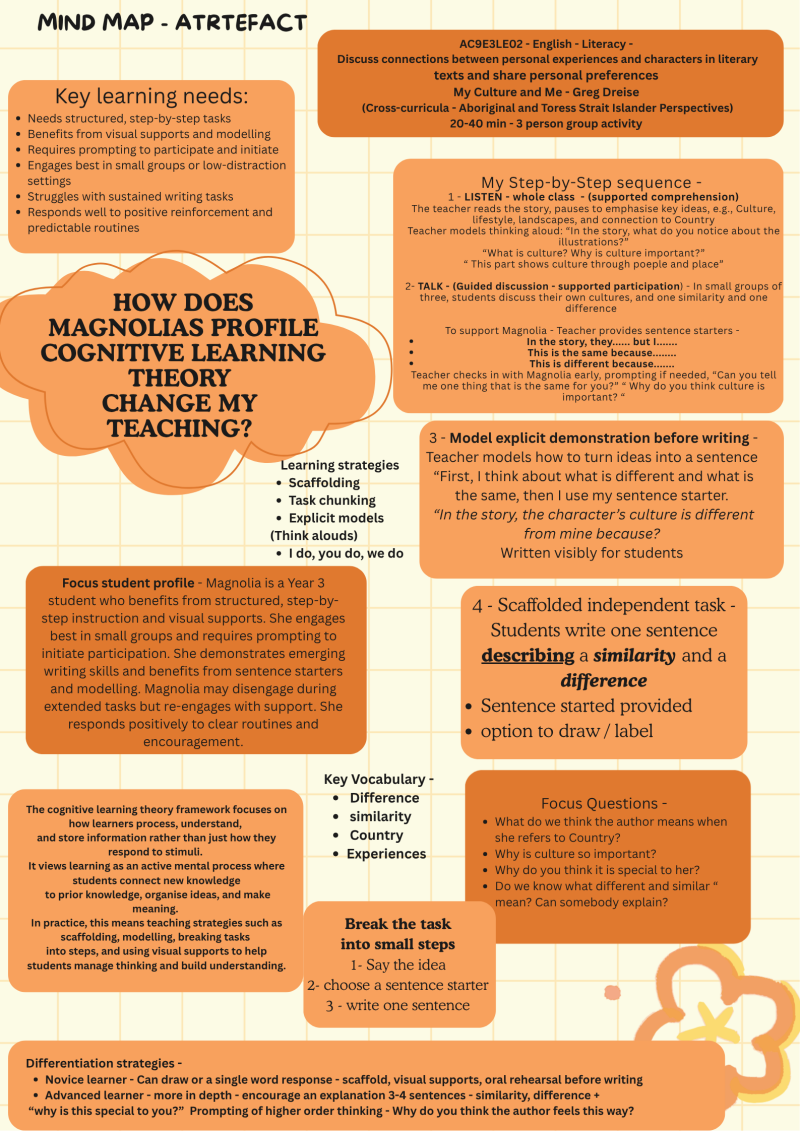
Artefact 1 – This mind map is the most significant component of my planning process, continuously refined and expanded until Week 9 as my knowledge and research developed.
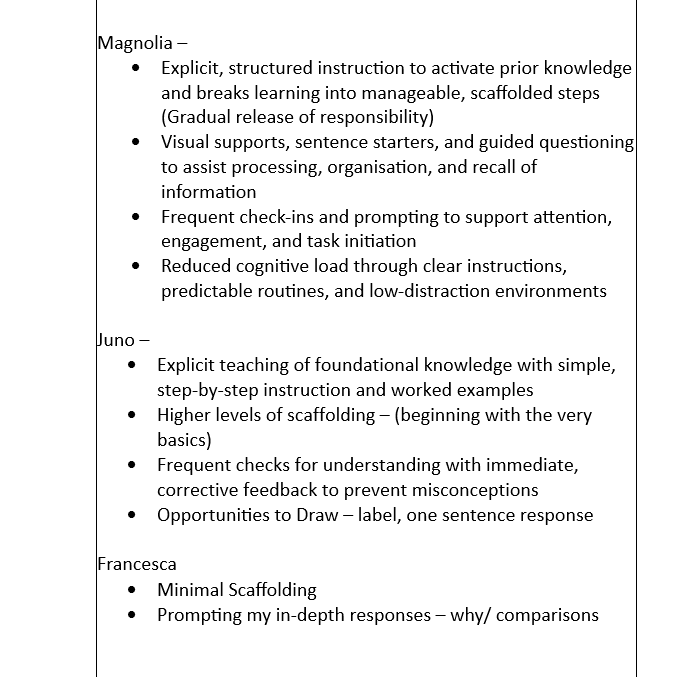
Artefact 2 - May look like just a few dot points- but this took hours and hours of tweaking to ensure the step-by-step process was clear - for myself as the teacher and my learners. Rosenshine (2012) principles of instruction influenced my decision making drastically
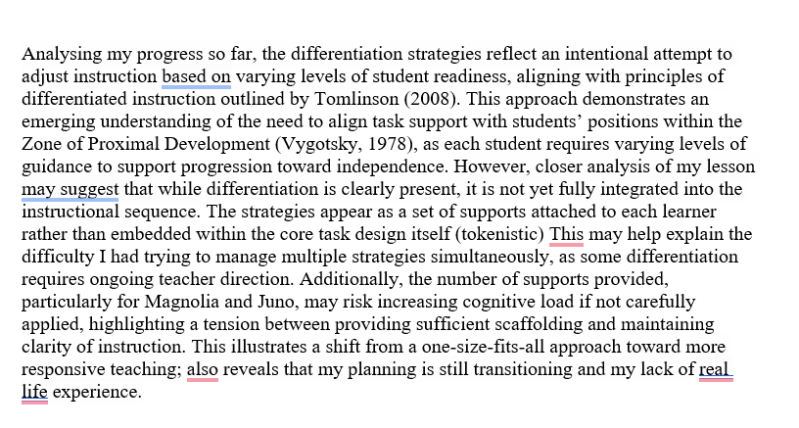
Artefact 3 -Journal entry as I began my research into integrating theory into my own work, a part I enjoy; however, I was overwhelmed with information and ensuring i only put what was essential
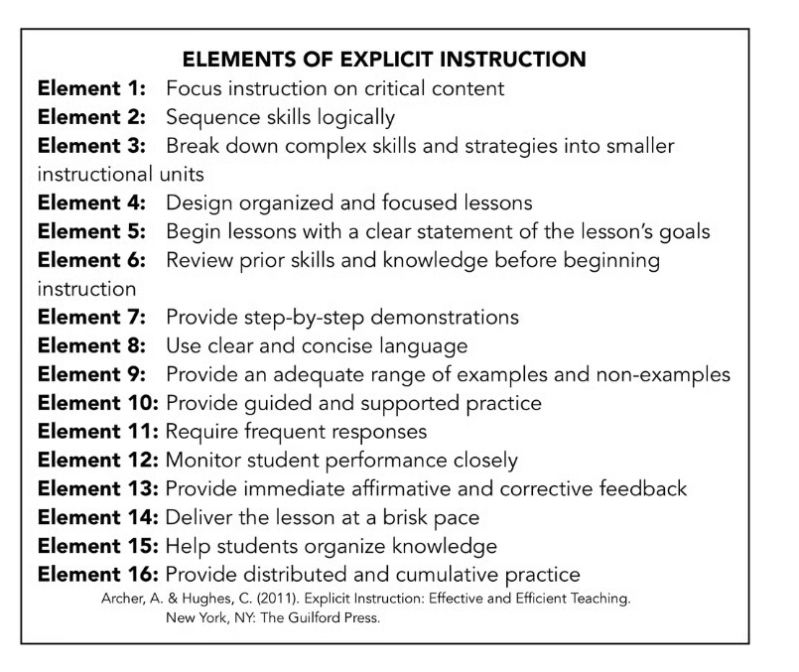
Artefact 4 – The 16 Elements of Explicit Instruction Framework used to guide lesson design and structure.

Artefact 5 - This A2 workbook & table served as my checklist throughout this whole process (being such a big project, I needed to re-watch it so many times to ensure important information didn't fall through the cracks). ( So many times, I forgot to put something crucial in that I read/thought of - Still feeling completely overwhelmed even at this stage - to be honest, a lot of self-doubt) - My study desk is covered in chaos of handwritten notes and open textbooks - I find it easier to retain information if I write it down and highlight it (old fashioned)
Analysis
As my lesson plan has taken shape, the cognitive learning theory has significantly shaped my approach to understanding how students process, store, and retrieve information, which has made me realise how fundamentally important it is to intentionally design lessons to reduce cognitive overload and support long-term learning (Duchesne, 2019, p. 230). Previously, I believed that covering more content meant students were learning more, but I now understand that depth, clarity and structured progression are far more important than pace. The distinction between novice and advanced learners particularly deepened my understanding of differentiation. Novice learners require carefully scaffolded instruction, worked examples and smaller learning steps, while advanced learners benefit from opportunities for extension, deeper thinking, and increased independence (Tomlinson, 2014, p.12).
Moving from a novice learner towards mastery requires careful sequencing and task chunking so that each skill and piece of knowledge builds towards the overall learning goal. This aligns with cognitive load theory, which explains that novice learners can easily become overwhelmed when too much new information is introduced at once, making it difficult for them to process and retain it (Sweller, 1988, p. 261). In addition, I have become more aware of the role of prior knowledge in the learning process and how crucial it is to intentionally activate relevant prior knowledge at the beginning of lessons. By doing this, students make meaningful connections and strengthen their understanding (Ausubel, 1968, p. 38). Overall, this has shifted my planning to be more purposeful and aligned with how students learn, rather than simply focusing on content delivery.
Lev Vygotsky’s concept of the Zone of Proximal Development (Duchesne, 2019, 103), reinforced the importance of providing support just beyond what a learner can do independently. This highlighted that effective teaching needs to be constantly adjusted based on student responses while reinforcing the need to carefully scaffold learning so that students are appropriately challenged without becoming overwhelmed. Similarly, Rosenshine’s principles of instruction further reinforced the value of explicit modelling, guided practice and regular checking for understanding. I now recognise that checks for understanding are not simply "add-ons"; they are essential for determining whether students are cognitively ready to progress. This highlighted that effective teaching is not just about planning support, but about continuously adjusting that support based on student responses during the lesson.
Ausubel's theory on prior knowledge also changed my approach to lesson planning. I realised that activating prior knowledge must be intentional and specific rather than broad and assumed. Activating prior knowledge also needs to be intentional and specific. As Ausubel suggests, learning is more effective when new information is connected to what students already know (Ausubel, 1968, p. 38). Students may appear engaged without necessarily making meaningful cognitive connections. As a result, I now see questioning as a critical instructional tool for connecting new learning to existing understanding. As the Australian Education Research Organisation (2025) explains, learning depends fundamentally on how students process and retain information, which means that questioning should guide students to the relevant prior knowledge needed to build new learning.
I am still not certain if my worked example is correct (Australian Education Research Organisation, 2024), but I now recognise how essential they are when lesson planning, as it allows me to clearly model the steps and thinking required for a task, while proactively fine-tuning it to ensure effective differentiation (Tomlinson, 2014, pp. 3,4). In addition, Carol Ann Tomlinson’s work on differentiation has influenced my thinking about how to respond to diverse learners. While all students benefit from explicit instruction, differentiation becomes important during application, where tasks can be adapted to different levels of readiness. This ensures that all students are appropriately supported and challenged, rather than simply completing the same work at different speeds (Tomlinson, 2014, p. 25).
This reflection also deepened my understanding of classroom routines and safe learning environments. Effective differentiation and explicit instruction rely heavily on predictable classroom structures and routines. Without these routines, cognitive overload can increase, transitions become inefficient, and learning time is reduced. I now understand classroom management less as behaviour control and more as creating a safe, supportive structure where students can focus on learning. This whole process has reinforced my understanding that structured instructional frameworks like GRR are fundamental in guiding students from supported learning towards confident, independent thinking (Fisher & Frey, 2014, p. 3).
Australian Education Research Organisation. (2024). Teach explicitly: Practice guide for primary and secondary schools.
Australian Education Research Organisation. (2025, April). Knowledge and memory: Learning is a change in long-term memory [PDF]. Australian Education Research Organisation.
Ausubel, D. P. (1968). Educational psychology: A cognitive view. Holt, Rinehart & Winston.
Duchesne, S., McMaugh, A., Bochner, S., & Krause, K. L. (2019). Educational psychology for learning and teaching (6th ed.). Cengage Learning Australia.
Fisher, D., & Frey, N. (2014). Better learning through structured teaching: A framework for the gradual release of responsibility (2nd ed.). ASCD.
Rosenshine, B. (2012). Principles of instruction: Research-based strategies that all teachers should know. American Educator, 36(1), 12–19, 39.
Sweller, J. (1988). Cognitive load during problem solving: Effects on learning. Cognitive Science, 12(2), 257–285.
Tomlinson, C. A. (2014). The differentiated classroom: Responding to the needs of all learners (2nd ed.). ASCD.
Vygotsky, L. S. (1978). Mind in society: The development of higher psychological processes. Harvard University Press.